 Close
Close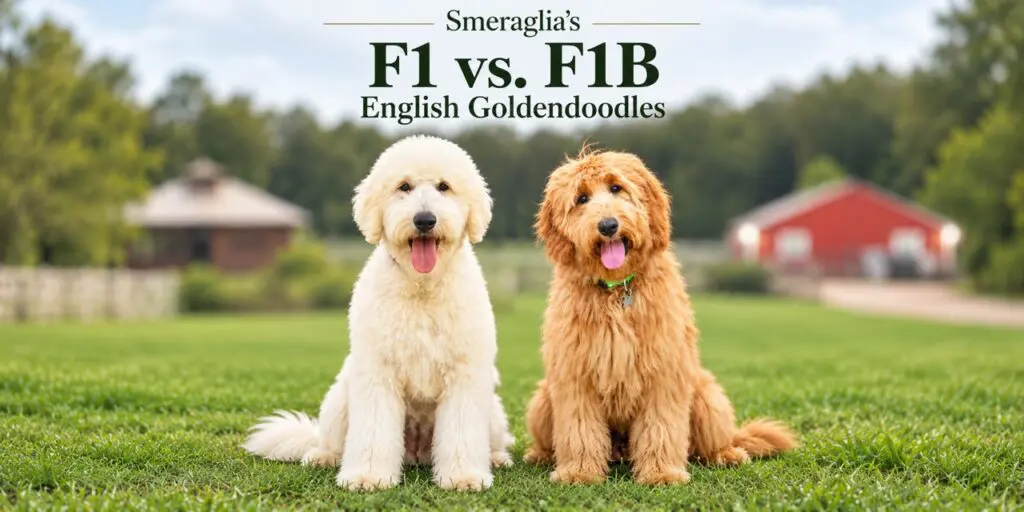
I love this question because it gets to the heart of what we do here at Smeraglia’s.
The first-generation cross brings together two wonderful dogs: our English Golden Retrievers and Poodles. We love the combination of their qualities, and for many families, an F1 English Goldendoodle is exactly what they’re looking for.
So why continue into F1B and later generations?
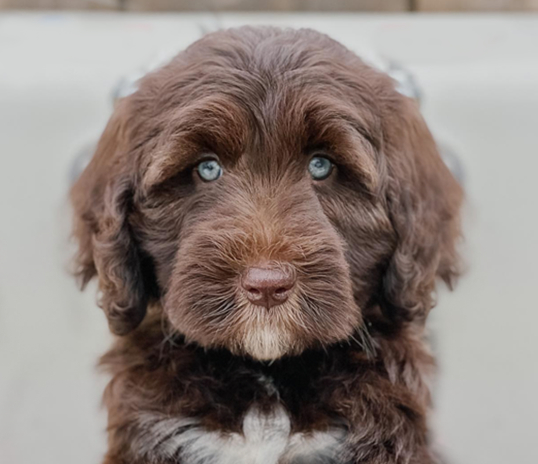
The answer begins with coats, shedding, color, and the needs of the families who come to us. But it also has a great deal to do with that plush teddy bear look we love.
What Is an F1 English Goldendoodle?
An F1 English Goldendoodle is a first-generation cross between an English Golden Retriever and a purebred Poodle.
There is something very special about that original pairing. As a breeder, I consider it a beautiful foundation for our English Goldendoodles.
Our English Golden Retrievers typically have an ultra-cream coat with black pigmentation. While individual dogs can vary somewhat, the English Golden Retriever generally brings a much more limited color range to the breeding program than the Poodle.
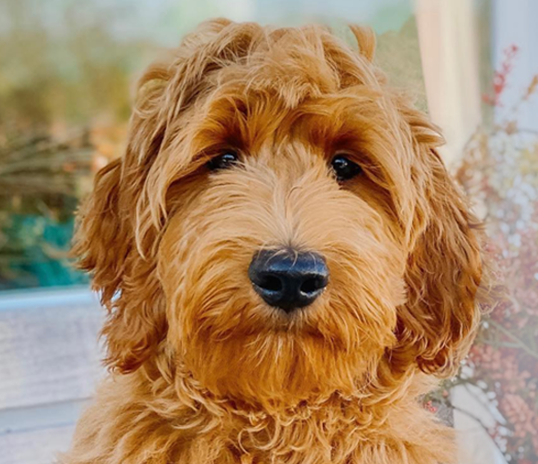
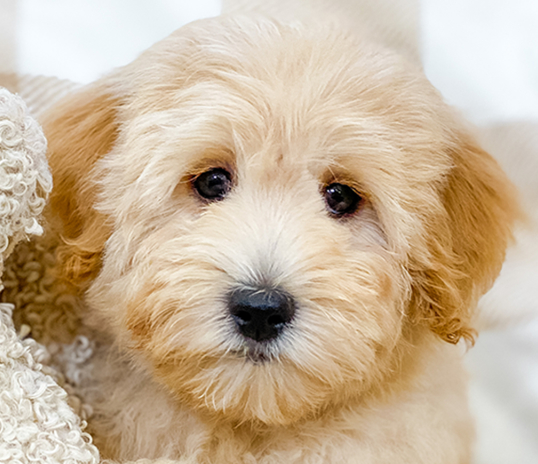
Our F1 English Goldendoodles often show the cream coloring we love, but their color possibilities depend on the Poodle parent and the genetics each puppy inherits. F1 puppies can also inherit other colors; cream is not the only possibility.
A first-generation cross does not produce identical puppies. Even within the same litter, we can see differences in coat texture, curl, furnishings, and overall appearance. Some puppies lean more toward their English Golden Retriever parent, while others show more Poodle influence.
For a family comfortable with some shedding and variation in coat, an F1 English Goldendoodle may be a wonderful fit.
For another family, especially one interested in reduced shedding, a particular coat type, or more color options, we may need to look more closely at an F1B or later-generation breeding.
Visit our F1 Teddy Bear English Goldendoodle photo gallery (https://www.teddybeargoldendoodles.com/gallery/f1-english-goldendoodles-gallery/?filter=photos) to see examples of this beautiful first-generation cross.
What Is an F1B English Goldendoodle?
An F1B English Goldendoodle is a first-generation English Goldendoodle bred back to one of its parent breeds—most commonly a Poodle.
The “B” stands for “backcross.”
When that backcross is to a Poodle, the purpose often includes increasing the likelihood of coat traits associated with reduced shedding. Carefully selected pairings can also open the door to a wider variety of colors and patterns.
An F1 English Goldendoodle has one English Golden Retriever parent and one Poodle parent. Our English Golden Retrievers contribute the beautiful ultra-cream coloring we love, but do not bring the same range of color possibilities found in Poodles.
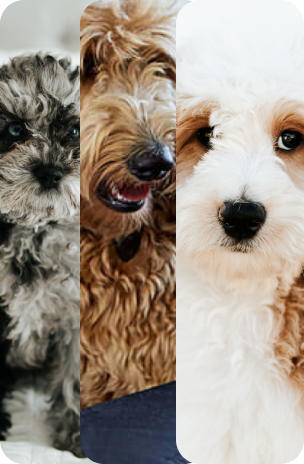
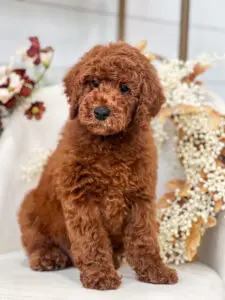
In an F1B breeding, we can select a Poodle that carries genes for additional colors and patterns, such as red, apricot, or parti—a coat with white areas and another color. Depending on what both parents carry, these pairings can expand the possibilities in our breeding program.
This is one reason many families enjoy looking at F1B and later-generation English Goldendoodles. They may have more options when it comes to coat color, pattern, and overall appearance, while still offering the qualities families love in a Goldendoodle.
Of course, the generation label alone does not guarantee a color. Genetics can be complex, and every puppy inherits a unique combination of traits from its parents.
Explore our F1B Teddy Bear English Goldendoodle photo gallery (https://www.teddybeargoldendoodles.com/gallery/f1-b-english-goldendoodles/?filter=photos) to see examples of their coats, colors, and teddy bear appearance.
Why Do We Breed Beyond F1?
At Smeraglia’s, we aren’t simply trying to produce another generation label.
We’re working toward consistency.
We want that beautiful, plush teddy bear coat. We want the soft, full face and the overall appearance that families recognize in our TeddyBear English Goldendoodles.
We also appreciate the additional color variety that thoughtful F1B and later-generation breeding can provide. Families may love the classic ultra-cream look of an English Goldendoodle, while others are drawn to red, apricot, parti, or other beautiful Poodle-influenced colors and patterns.
That means carefully considering the parents we pair, the traits they carry, and what we have learned from their lines.
Over time, we develop a clearer understanding of which pairings are more likely to produce the qualities we’re looking for—including coat texture, furnishings, shedding tendencies, size, temperament, and color.
It is much more thoughtful than assuming that any English Golden Retriever and any Poodle will produce the same result.
And yes, genetics still surprises us! Puppies are living individuals. Even a carefully planned breeding can give us differences we didn’t expect.
Our goal is greater consistency, while respecting that natural variation.
Is a Teddy Bear Coat Always Curly?
No—and this is something I want families to understand.
A teddy bear appearance is not simply about having the tightest curls.
A beautiful coat may be wavy or curly. The fullness around the face, coat texture, and furnishings—the facial hair that helps create that familiar doodle expression—all contribute to the look.
Grooming also helps shape that teddy bear appearance.
When you look through our F1 English Goldendoodle gallery (https://www.teddybeargoldendoodles.com/gallery/f1-english-goldendoodles-gallery/?filter=photos) and our F1B English Goldendoodle gallery (https://www.teddybeargoldendoodles.com/gallery/f1-b-english-goldendoodles/?filter=photos), notice the variety in coat texture, coloring, and overall appearance.
Those pictures show examples of our dogs, rather than a promise that every puppy in a generation will look exactly alike.
You can also explore our complete photo gallery (https://www.teddybeargoldendoodles.com/photos/) to browse galleries organized by generation and coat color.
What About Allergies and Shedding?
Concerns about allergies and shedding are a major reason families ask about F1B and later-generation English Goldendoodles.
Breeding toward reduced shedding can help us address part of that concern. But shedding and allergies are not the same thing.
Dog allergens are associated with proteins found in saliva, dander, and urine—not just loose hair. A low-shedding dog can still trigger an allergic reaction.
That is why we don’t believe a generation label should be treated as an allergy guarantee. Families with allergies need a conversation about their particular situation and the individual dog.
Which English Goldendoodle Generation Is Best?
The better question is: Which individual puppy is the best fit for your family?
An F1 English Goldendoodle may be a wonderful choice, especially for families who love that original cross and are comfortable with more variation in coat and shedding.
An F1B or later-generation English Goldendoodle may offer coat traits that better match what you’re looking for, along with more possibilities for colors such as red and apricot or patterns such as parti.
But choosing your puppy should also include temperament, expected size, activity level, shedding tendencies, color preferences, and the care that coat will need.
At Smeraglia’s, our goal is to bring those pieces together: a thoughtfully bred English Goldendoodle, that beautiful teddy bear appearance, a coat and color that suit your preferences, and a family who loves and understands the dog in front of them.
The letters help explain the breeding. They don’t tell the whole story.
Find Your TeddyBear English Goldendoodle
Whether you love classic cream, rich red, soft apricot, or a beautiful parti coat, we’d love to help you find a puppy whose personality is just as appealing as their looks.
Meet our available puppies (https://www.teddybeargoldendoodles.com/puppies/) and find the little face that catches your heart. Tell our adoption team what matters most to you—from temperament and size to coat and color—and let us help you take the next step toward bringing your Smeraglia puppy home.
— Sherri Smeraglia