 Close
Close
A funny conversation happened at Smeraglia this morning.
One of our wonderful clients was sitting in the Chapel Bar on Gotcha Day talking with Angie. She was admiring her beautiful new puppy “Sunny”and said:
“This is my third puppy from y’all, and I’m so excited! But I noticed my puppy is listed as an F3. What exactly does that mean?”
Now, Angie is our Hospitality Manager. She can tell you where the coffee is, where the bathrooms are, and where the puppy kisses are being handed out. But when the conversation starts drifting into canine genetics, she wisely called for backup.
So let’s talk about it.
Doodle Generations Are Like a Family Tree
Sometimes doodle genetics can feel a little like showing up at a family reunion.
You know everybody belongs there.
You know everybody is related somehow.
You’re just not entirely sure how Cousin Billy is connected to Aunt Martha.
The good news is that doodle generations are actually much simpler than they sound.
Let’s start at the beginning.
The First Generation
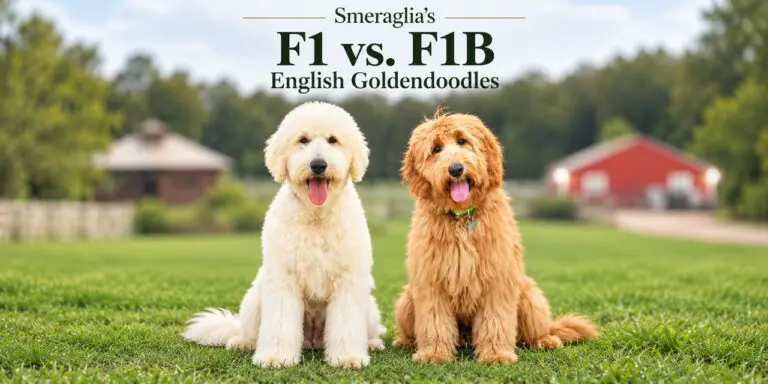
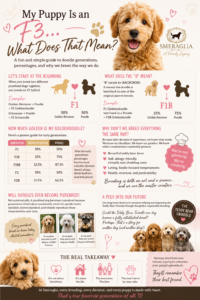
When you breed two different purebred dogs together, you create an F1 hybrid.
For example:
- Golden Retriever + Poodle = F1 Goldendoodle
- Schnauzer + Poodle = F1 Schnoodle
The “F” simply stands for filial, which means generation.
Think of the F1 as the very first branch growing from two separate family trees.
Simple enough.
Then Comes the Mysterious Letter “B”
The “B” stands for Backcross.
A backcross occurs when an F1 doodle is bred back to one of its original parent breeds.
For example:
An F1 Goldendoodle bred back to a Poodle creates an F1B Goldendoodle.
Breeders often do this because it can improve coat consistency and increase the likelihood of producing the soft, allergy-friendly, low-shedding coats many families are looking for.
Then people start hearing things like:
F1.
F1B.
F2.
F2B.
F3.
And somewhere around this point, many families start smiling politely while secretly thinking:
“I hope there isn’t a test later.”
Why Isn’t Every Doodle Automatically an F3?
This is where many people get confused.
Generations don’t simply advance because another litter is born.
The breeding combinations matter.
An F1 bred to an F1 creates an F2.
An F1B bred to another F1B can advance the generations further.
But breeding an F1 to an F1B doesn’t automatically create an F3.
The genetics have to line up according to established breeding formulas used throughout the hybrid breeding world.
These aren’t rules that doodle breeders invented. They’re accepted genetic classifications that help describe how dogs are related and how far removed they are from the original cross.
Okay, But How Much Golden Retriever Is My Goldendoodle?
This is usually the next question.
For the early generations, the math is fairly straightforward.
An F1 Goldendoodle is approximately:
- 50% Golden Retriever
- 50% Poodle
An F1B Goldendoodle is approximately:
- 25% Golden Retriever
- 75% Poodle
An F1BB Goldendoodle is approximately:
- 12.5% Golden Retriever
- 87.5% Poodle
An F2 Goldendoodle is approximately:
- 50% Golden Retriever
- 50% Poodle
An F2B Goldendoodle is approximately:
- 37.5% Golden Retriever
- 62.5% Poodle
But once you move into multigenerational breeding, things become more complicated.
Genetics doesn’t always divide itself into neat little pieces.
A puppy might inherit more coat characteristics from one side of the family and more temperament traits from another. That’s why two puppies from the same litter can sometimes look surprisingly different while still sharing the same parents.
Why Don’t We Just Breed Everything the Same Way?
This might be my favorite question of all.
Once families understand the generations, they often ask:
“Why did you make this litter an F1B?”
Or…
“Why not just breed everything the same way?”
The answer is simple.
Because after decades of breeding, we’ve learned what works.
Think of it like a family recipe.
If you’ve ever watched a grandmother make biscuits, you know she doesn’t always need measuring cups. She knows her recipe because she’s made it hundreds of times.
Breeding dogs is very similar.
Over the years, we’ve learned our bloodlines.
We know our genetics.
We know our dogs.
We know which combinations consistently produce the beautiful teddy bear faces our families love.
We know which pairings are most likely to produce soft, allergy-friendly, virtually non-shedding coats.
We know which bloodlines consistently produce the loving, family-focused temperaments that have become a hallmark of Smeraglia dogs.
So when we’re selecting breeding pairs, we’re not randomly putting two dogs together and hoping for the best.
There’s a tremendous amount of thought behind every decision.
Every breeding is intentional.
Every pairing has a purpose.
Every decision is made with the next generation in mind.
The Art and Science Behind the Teddy Bear Look
People often assume breeding is simply about putting two beautiful dogs together.
The truth is, it’s both an art and a science.
Our goal isn’t just to produce puppies.
Our goal is to produce puppies that consistently embody the characteristics families have come to expect from Smeraglia.
The teddy bear appearance.
The soft coat.
The friendly personality.
The allergy-friendly, virtually non-shedding coat.
The predictability.
When we choose a breeding pair, we’re evaluating health testing, temperament, structure, coat genetics, pedigrees, and years of historical data from our own program.
In other words, we’re not guessing.
We’re creating.
And after doing this for so many years, we’ve become pretty good at knowing which ingredients need to come together to create the puppy we’re envisioning.
The generation isn’t the goal.
The outcome is.
Will Doodles Ever Become Purebred?
This is another question we hear often.
The answer is: not automatically.
A dog doesn’t become purebred simply because enough generations have passed.
A purebred dog becomes a purebred because generations of breeders consistently select for specific traits, establish a breed standard, and reliably reproduce those characteristics over time.
In fact, every purebred breed we know today started somewhere.
At one point, there was no such thing as a Golden Retriever.
There was no such thing as a Poodle.
There was no such thing as a Schnauzer.
Dedicated breeders spent years—often decades—developing those breeds into the dogs we recognize today.
A Little Peek Into the Future
Many of you know that one of our greatest passions is the Teddy Bear Twoodle.
The Teddy Bear Twoodle combines the wonderful qualities of the English Goldendoodle and the Teddy Bear Schnoodle into something truly special.
Our long-term vision is to continue refining and improving this breed through thoughtful, responsible breeding practices.
Could there come a day when the Teddy Bear Twoodle stands as a fully established breed with generations of consistency behind it?
Perhaps.
That’s certainly part of the dream.
But that’s a much bigger story—and honestly, it deserves an entire blog of its own.
We’ll save that conversation for another day.
The Real Takeaway
Whether your puppy is an F1, F1B, F2, F2B, F3, or multigenerational, the most important thing isn’t the letters in front of the name.
It’s the life that’s about to be lived with that puppy.
The walks.
The snuggles.
The family vacations.
The children growing up together.
The memories.
Because years from now, nobody is going to be sitting on the couch saying:
“Remember when we brought home our F3?”
They’re going to be saying:
“Remember when we brought home our best friend?”
And that’s our favorite generation of all.
P.S. If this made you want a doodle of your own, meet our English Goldendoodle puppies and start your adoption application — we’d love to meet your family.