


 Close
Close
By Sherri Smeraglia
Oh, how I love this question! When a family asks me which doodle is right for them, I want to hear about the life that puppy will be joining. Tell me about your children, your daily routine, your hopes for a companion, and whether dog allergies are part of your story. Those details help us begin a conversation that is much more personal than choosing a favorite puppy picture.
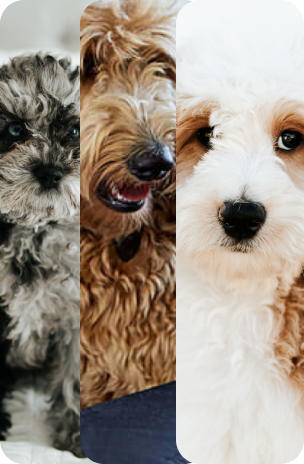
Here at Smeraglia, we raise TeddyBear Goldendoodles, TeddyBear Schnoodles, and TeddyBear Twoodles. I love all three. We put care into health, genetics, and temperament throughout our breeding program, and each of these dogs has a special place in our hearts.
What I am sharing here comes from my own experience with our Smeraglia dogs and the families we work with. It describes our breeding program and how we approach matching. It should not be read as a description of every doodle or of what other breeders do.
Meet Our Three TeddyBear Doodles:
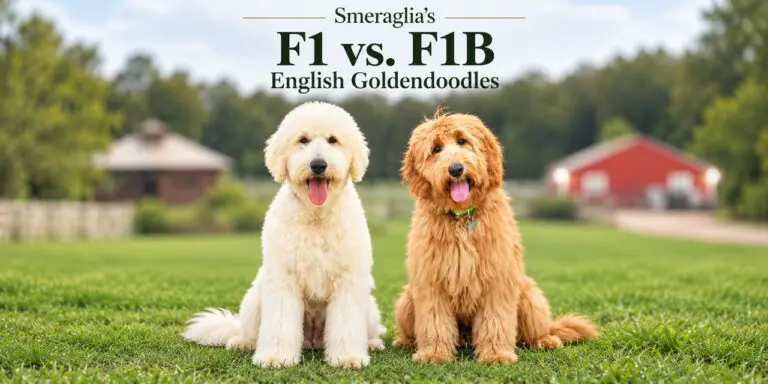
Our Goldendoodles bring together Golden Retriever and Poodle ancestry. Within our program, we work with different generations, sizes, and individual temperaments. Families often have questions about the letters beside a puppy’s name, and we are happy to explain what those letters tell us about that puppy’s parentage.
Our Schnoodles bring together Schnauzer and Poodle ancestry. They are an important part of our Smeraglia family, including our conversations with families who have concerns about dog allergies. We love helping people get to know the individual puppies behind those sweet TeddyBear faces.
Our Twoodle is a Smeraglia Goldendoodle bred to a Smeraglia Schnoodle. After years of raising our Goldendoodles and Schnoodles, we saw a need for this combination, including among families looking for an additional option when allergies were a consideration. That work became our TeddyBear Twoodle. And yes, we spell it T-W-O-O-D-L-E!
We do not divide our Twoodles into F1, F1B, F1BB, F2B, or multigenerational categories. When we talk about a Twoodle here, we mean that intentional Goldendoodle-to-Schnoodle pairing.
When dog allergies are part of your decision:
If someone in your family has dog allergies, please tell us early. I know how much hope can be wrapped up in the thought of finally having a dog to love, and I want that conversation to begin with care and honest expectations.
In my experience within our own program, our Schnoodles have been our first starting point for allergy-sensitive families, followed by our Twoodles, then our Goldendoodles. This is the order we use to explore options based on our observations. It is not a medically established ranking, and it cannot predict how a particular person will respond to a particular dog.
The word “allergy-friendly” also deserves an explanation. We use it to describe our experience working with families and individual dogs. It does not mean allergy-free. Dog allergens are proteins found in sources including dander, saliva, and urine; shedding alone does not tell you whether someone will react. No breed or generation can promise an allergy-free home. [1]
For someone with significant allergies, asthma, or a history of serious reactions, an allergist should help determine whether any dog exposure is appropriate before arranging a visit or a shirt exposure. Our role is to share what we know about our dogs and our process; medical guidance belongs with your clinician. [1]
Understanding Goldendoodle Generations:
Among our Goldendoodles, three labels often come up in these conversations. An F1 is the first Golden Retriever and Poodle cross. An F1B commonly describes an F1 Goldendoodle bred back to a Poodle. An F1BB commonly describes a further backcross to a Poodle. Ask us about the actual parents of the puppy you are considering so you understand that puppy’s particular background.
We have worked with families who tolerate our F1 Goldendoodles, while others explore our F1B or F1BB options. When we consider a Goldendoodle during an allergy visit, we typically begin with an available F1BB or F1B that we believe is an appropriate starting point within our program.
Those letters describe ancestry. They are not an allergy score or a guarantee. A curlier coat, a higher proportion of Poodle ancestry, or another family’s positive experience cannot establish that a puppy will work for your household.
How We Approach an Allergy Visit at Smeraglia:
Our allergy visits are arranged through the office by appointment. Please share your allergy history before making travel plans, and obtain any needed medical guidance first. We want the visit planned around your circumstances rather than treated as a casual drop-in.
Our usual starting point is a Schnoodle. Depending on the person’s response and the visit plan, we may then consider a Twoodle after an appropriate interval. If it makes sense to explore a Goldendoodle, we generally begin with one of our available F1BB or F1B options. We discuss the sequence and timing with each family rather than promising a fixed schedule for everyone.
A reaction is a reason to stop and reassess. We do not encourage anyone to push through symptoms or continue trying dogs after a reaction. Any later exposure should follow appropriate medical advice, especially when breathing symptoms or asthma are involved. [1]
A comfortable visit can provide one observation about that exposure. It cannot reproduce every aspect of living with a dog over time, including allergens accumulating in the home. We want you to understand that limitation before making a commitment.
Our T-shirt Option for Families Who Cannot Visit:
For families who cannot come to the farm, we also offer a paid T-shirt exposure service. In our process, a shirt is exposed to a particular dog through wear and contact with the dog’s coat and saliva, then shipped overnight to the family. Our team explains the current preparation process, arrangements, and fee before proceeding.
Over the years, some families have reported reactions to these shirts. That information has helped them pause and reconsider a particular dog. Other families have reported no reaction during the shirt exposure.
Although we have traditionally called this our “T-shirt allergy test,” it is an informal exposure service. It is not a validated medical allergy test, does not diagnose an allergy, and cannot establish that a dog will be safe for you. No reaction to a shirt does not rule out a later reaction to the dog. If you have significant allergies or asthma, speak with your allergist before considering this option.
Four Size Categories with Some Important Differences:
Each of our three doodle types comes in four size categories: Extra Small, Small, Medium, and Large. Our Goldendoodles and Twoodles follow the same general size ranges in our program. Schnoodle sizing needs a little extra explanation, particularly in the two smallest categories.
|
Size |
Goldendoodles and Twoodles |
Schnoodles |
|
Extra Small |
Parallel size ranges in our program. |
Our Extra Small Schnoodle is smaller than the corresponding Goldendoodle or Twoodle category. |
|
Small |
Parallel size ranges in our program. |
A different size range; ask about the particular litter rather than assuming the same measurements. |
|
Medium |
Matching general size category. |
Comparable general size category; individual builds and weight estimates can differ. |
|
Large |
Matching general size category. |
Comparable general size category, also called Giant on our Schnoodle pages; individual estimates can differ. |
Size labels are a starting point. Ask us about expected adult height, build, and weight for the individual puppy and its parents. These are estimates rather than exact adult-size promises. Two dogs with a similar height can have different builds, and a full TeddyBear coat can make a dog look bigger, too.
Think about everyday life as you consider size. Will you need to lift your dog? Are there young children in the home? How will your dog ride in the car? A petite puppy and a larger companion can each bring so much joy, but their practical needs deserve a little thought before you fall in love with a photograph.
Temperament Brings the Whole Conversation Together:
Once we understand your allergy considerations and size preferences, I want to hear more about your family. Do you enjoy a busy household and outdoor adventures? Are you hoping for quieter companionship? Are there other dogs, children, or grandchildren whose needs should be part of the conversation?
We look at the puppy in front of us. Breed names can tell you about ancestry, but they do not tell you everything about confidence, energy, sociability, or the support a particular puppy may need.
Our temperament assessments at around seven weeks help us learn about each puppy and guide our matching conversations. They are observations during early development, not a promise of an unchanging adult personality. Your puppy will continue learning through socialization, training, and everyday experiences with you.
Goldendoodles, Schnoodles, and Twoodles all need grooming, patient training, companionship, and appropriate activity. A low-shedding coat still needs care. We can discuss the individual puppy’s coat and what brushing and professional grooming may involve, along with whether Doodle Prep School would be useful for your family.
Questions I Would Love Your Family To Ask:
Let us help you get to know your options!
You are welcome to begin with a favorite. Maybe a Schnoodle’s little face has captured your heart, a Goldendoodle is the dog you have always imagined, or you are just discovering our Twoodles. Bring us your questions! We are happy to help you learn about all three.
My hope is that you leave the conversation feeling informed, cared for, and excited about what comes next. There is so much joy in welcoming a puppy, and taking time to understand your family’s needs is a lovely place to begin.
To explore our puppies or talk about an appointment, visit teddybeargoldendoodles.com/puppies/, email [email protected], or call our office at 251-960-1311. Please arrange all farm visits through our office before making travel plans.
With love,
Sherri
Further reading
[1] American Academy of Allergy, Asthma & Immunology, Pet Allergy Symptoms, Diagnosis, Treatment & Management. https://www.aaaai.org/conditions-treatments/allergies/pet-allergy
Smeraglia size references: https://www.teddybeargoldendoodles.com/prices/ and https://www.teddybeargoldendoodles.com/schnoodle-sizes-colors-coats/. Size categories in this article describe our program; ask our team for current individual puppy estimates.