







 Close
Close
Last week, we talked about a nose that knows.
Today, we’re talking about ears that listen.
Not just hear.
Listen.
If you live with one of our doodles, you already understand this without needing a scientific explanation.
They hear the car before it turns into the drive.
They hear the ice dispenser from across the house.
They hear the faint click of a treat jar lid being touched — not even opened — touched.
And yet…
Sometimes they do not hear you say, “Come.”
Fascinating.
⸻
The Science Behind Those Velvet Ears
All dogs hear at extraordinary ranges — far beyond what we can.
Humans typically hear up to about 20,000 Hz.
Dogs can hear up to around 65,000 Hz.
They detect:
- Higher pitches
- Softer sounds
- Subtle vibrations
- Tone shifts we don’t even realize we’re making
They can hear sounds nearly four times farther away than we can.
So yes — when your doodle suddenly lifts their head and stares into the distance while you hear absolutely nothing…
It’s not drama.
It’s physics.
⸻
Hearing Is Biological. Processing Is Genetic.
All dogs can hear.
Not all dogs process sound the same way.
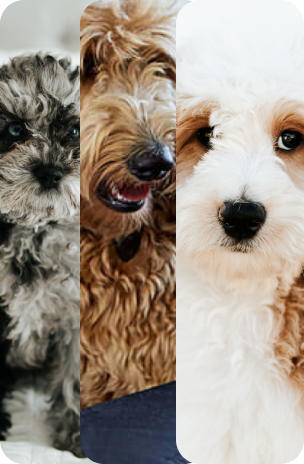
And because we raise three distinct lines at Smeraglia — English Goldendoodles, Teddy Bear Schnoodles, and Teddy Bear Twoodles — it’s worth understanding how genetics shape response.
🧬 The Poodle Influence
Poodles are brilliant. Highly perceptive. Environmentally aware.
They notice everything — sometimes before you do.
🧬 The Schnauzer Influence
Schnauzers were farm sentinels. Alert dogs. Designed to signal change.
They register unfamiliar sounds quickly and confidently.
🧬 The Golden Retriever Influence
Goldens are steady. Cooperative. Emotionally stable.
They hear — but they do not overreact.
When we blend these lines, we aren’t improving hearing ability.
We are shaping sound response.
- English Goldendoodles tend to hear first and respond calmly.
- Teddy Bear Schnoodles often register sound changes immediately — observant, attentive, aware.
- Teddy Bear Twoodles carry that beautiful balance of alertness and steadiness.
Sensitivity, when properly bred and properly raised, is not fragility.
It is intelligence.
⸻
Let’s Address “Selective Hearing”
Now.
We must address the elephant in the room.
If dogs can hear that well…
Why can they hear a cheese wrapper at 2:00 AM
but somehow cannot hear “leave it” at the park?
This is not a hearing problem.
It is a motivation problem.
Dogs are masters of cost-benefit analysis.
“Is what you’re offering better than what I’m currently investigating?”
If the answer is no… well… they may suddenly develop temporary deafness.
Which is precisely why training matters.
Listening is not about volume.
It is about clarity.
It is about leadership.
It is about relationship.
When a dog respects your communication and trusts your guidance, listening becomes natural.
⸻
Listening Is Cultivated at Smeraglia
At Smeraglia, listening does not happen by accident.
From early neurological exposure to the structured rhythm inside our Super Puppy Program, our puppies are intentionally introduced to:
- Household activity
- Vacuum cleaners
- Farm equipment
- Children laughing
- Doors closing
- Multiple voices
- Controlled environmental stimulation
We don’t shelter them from sound.
We teach them how to process it.
Exposure builds confidence.
Confidence builds composure.
Composure builds partnership.
And partnership is what families actually need.
⸻
Sensitive vs. Stable
People often ask,
“Are doodles sensitive to noise?”
The honest answer?
They are perceptive.
There is a difference.
Poor genetics or lack of early exposure can turn perception into anxiety.
Stable genetics combined with thoughtful socialization turn perception into awareness.
A well-bred, well-raised doodle does not panic at sound.
They pause.
They process.
Then they look to you.
That look — that quiet check-in — is trust.
And that is what makes them extraordinary.
⸻
🧼 Ear Hygiene: Stewardship Matters
Now let’s talk about care.
Because those soft, beautiful, floppy ears require attention.
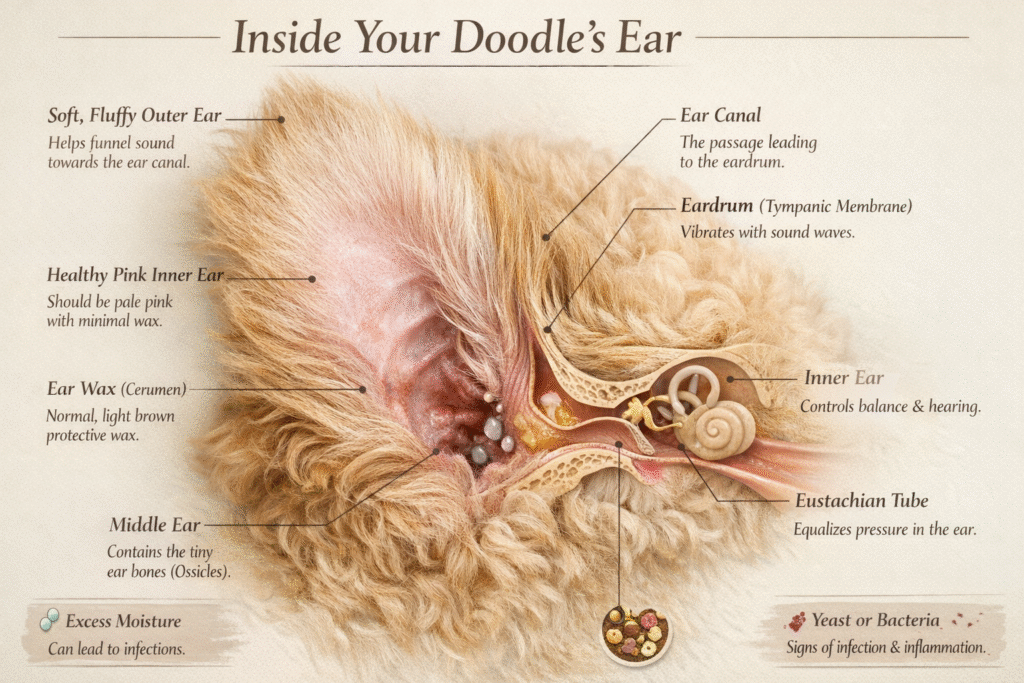
Floppy ears — especially with dense coat — create a warm, slightly enclosed environment.
Warmth + moisture = a place where yeast or bacteria can grow if neglected.
This is not alarming.
It is simply biology.
We recommend:
- Weekly ear checks
- Gentle, veterinarian-approved cleaning solution
- Thorough drying after bathing or swimming
- Monitoring for odor, redness, discharge, or frequent head shaking
Healthy ears should be:
- Pale pink
- Clean
- Neutral in scent
- Free of excessive buildup
If your doodle is shaking their head repeatedly or scratching persistently, that’s your cue to check.
Preventative care is always easier than treatment.
At Smeraglia, excellence in temperament must be matched by excellence in stewardship.
We cultivate listening.
We maintain the ears that make it possible.
⸻
Because if their ears listen…
Their eyes read the room.
And we’ll talk about that next.
⸻
🤍 Stay Connected
If you’re enjoying this series on the five senses of our doodles, follow along for the next installment.
Share this with a fellow doodle family.
Comment below — has your doodle ever demonstrated “selective hearing”? We know the stories are good.
And if you’re considering adding a Smeraglia puppy to your home, explore our programs and temperament-focused approach at TeddyBearGoldendoodles.com.
Excellence in breeding isn’t accidental.
It’s intentional.
P.S. If this made you want a doodle of your own, meet our English Goldendoodle puppies and start your adoption application — we’d love to meet your family.